
A Quiet Afternoon at Rietberg

Updated: Oct 4

Located in a leafy corner of Zurich, Museum Rietberg is a museum of World Art, presenting traditional and contemporary cultures from Asia, Africa, the Americas, and Oceania.
In addition to its exhibitions, the museum offers a wide range of programs, including talks, guided tours, and workshops. Each visit opens up a different way to encounter art and culture. If I lived nearby, it feels like the kind of place I would happily drop by every week.

One of the museum’s central buildings, Villa Wesendonck, was once the 19th-century residence of the silk merchant Otto Wesendonck and his wife, Mathilde. It also served as a kind of cultural salon and is known for its close connection to the composer Richard Wagner.
Museum Rietberg is not simply a place to see beautiful objects.
Within its buildings and exhibitions, many layers of history are quietly connected: 19th-century European wealth, encounters between artists, a fascination with the wider world, the legacy of the colonial era, private collections, public culture shaped by citizens, and today’s provenance research.
The museum was founded by the City of Zurich in 1952. At its core was the collection of non-European art assembled by Baron Eduard von der Heydt. The City purchased the area around Villa Wesendonck, and after a public vote, the site was developed into a museum.
Japan de luxe

Photo courtesy of Museum Rietberg, Zurich :Sonsai Kōitsu (active c.1820–1840), Paper making, 1823 © Museum Rietberg
One of the current exhibitions is Japan de luxe, which presents Japanese surimono prints.
Surimono are high-quality, privately commissioned polychrome woodblock prints produced mainly from the late 18th to the mid-19th century. Unlike widely circulated ukiyo-e prints, many were made in small editions for private gatherings or as gifts. Their refined beauty can be seen in every detail: the paper, colours, printing techniques, and composition.
The exhibition presents more than 100 surimono, mainly from the donation of Gisela Müller and Erich Gross. Some of the works are being shown to the public for the first time. In the quiet setting of a Zurich museum, visitors can take time to appreciate the delicate aesthetics condensed into these small Japanese prints.
Standing in front of the works, I felt that the beauty of surimono is not only in their decorative richness. It is also in their subtle colours, use of empty space, and connection to poetry and the seasons. Each piece seems to reveal how people of that time enjoyed, gifted, and shared beauty.
Memories of Japanese history learned in elementary school became a small guide through the exhibition. When I saw the name Minamoto no Yoritomo, it felt as if Japan’s distant past and the museum room in Zurich were quietly connected.
Fast ein Paradies

Photo courtesy of Museum Rietberg, Zurich :Wendy Red Star, Spring – Four Seasons, 2006 © Wendy Red Star, courtesy the artist; collection of the Newark Museum of Art
Another exhibition that stayed with me was Fast ein Paradies.
In this exhibition, contemporary artists revisit photographs and historical images from the colonial era through new perspectives. It is not simply a display of old photographs. Rather, it asks us to reconsider the relationships between the people shown in the images, the gaze of those who took them, and the way we, living in a later time, receive and interpret them.
At first glance, a photograph may appear to be a “record.” But the shape of history that remains in an image changes greatly depending on who took it, what was shown, and what was left outside the frame. Behind landscapes and portraits that may look beautiful, there can also be layers of power, control, longing, misunderstanding, and silence.
The title Fast ein Paradies is also striking. Was what appeared to be paradise truly paradise? And for whom was it paradise? As I walked through the exhibition, that question quietly stayed with me.
What makes this exhibition so compelling is that it does not present history as a single fixed truth. Instead, it looks at the past through multiple memories and perspectives. Through the works of contemporary artists, I felt that historical images are not fixed objects, but something we can read again through the eyes we have today.
Seeing this exhibition at Museum Rietberg also felt meaningful.
As a museum dedicated to cultures from around the world, Museum Rietberg does more than invite visitors to appreciate beautiful objects. It also encourages us to look at the histories behind them, and to ask why these works and images are here today.
That sincere attitude came through clearly in this exhibition.
Light and Stillness at Villa Wesendonck
Inside Villa Wesendonck, I was struck by the natural light pouring in through the large windows and the calm tone of the exhibition rooms. Even the shadows of light falling across the floor were beautiful, making me slow down naturally as I walked.
The rooms display religious art and cultural objects from different parts of Asia, including Tibet, Cambodia, and India. More than simply “viewing” the works, I felt the quiet overlap between 19th-century European villa culture and Asian spiritual traditions. At Museum Rietberg, it is not only the objects that remain in memory, but also the architecture, the light, the stillness, and the atmosphere of the rooms themselves.
I was also touched by the chairs placed quietly in the exhibition rooms. They invite visitors to sit down between encounters with the works. Time spent in the museum felt not only like an act of looking, but also like a moment to settle the mind.

Light as Part of the Exhibition
What struck me most inside Villa Wesendonck was how gently the light entered the space. The natural light from the large windows did not feel as if it was simply illuminating the works. Rather, it seemed to quietly fill the entire room. The shadows falling across the floor, the soft brightness spreading over the walls, and the greenery visible beyond the windows all made the experience of viewing the exhibition feel slower and more contemplative.
The light coming through the large window on the right stretched directly across the exhibition room floor, softly bringing out the texture of the herringbone wood. The floor did not feel like something merely beneath my feet. As it received the light, it seemed to give the whole room a quiet sense of movement.
The deep grey walls were also memorable. They allowed the exhibits to stand out gently while softly absorbing the light from the windows, creating a calm atmosphere throughout the room. Unlike a white-walled gallery, the space had a slightly subdued stillness, which naturally helped me focus on the works.
What stayed with me even more was the bench placed along the windows. Set in a position where visitors can face the works while also sensing the light from outside, it felt like more than a place to rest. It seemed to be a place to pause, stay for a while, and simply be present in the space.

I also loved the way the view opened into the next room.
The space did not end within a single room. Instead, the stillness seemed to continue softly into the rooms beyond. As I followed that flow, walking slowly from one space to the next, it felt less like simply “looking” at an exhibition and more like being surrounded by light, architecture, and art.
The room quietly reminded me that time spent in a museum is not only about gaining knowledge. It can also be a moment to settle the mind, especially when everyday life feels a little unsettled.
Café Time in the Garden Light
After walking through the exhibitions, you can also enjoy a relaxed lunch at the café, which seems to open gently toward the garden.
On this visit, I chose a salad bowl made with japchae glass noodles, served with vegetable mandu. The bowl was filled with noodles and beautifully topped with golden-brown mandu, mushrooms, green vegetables, and sprouts.
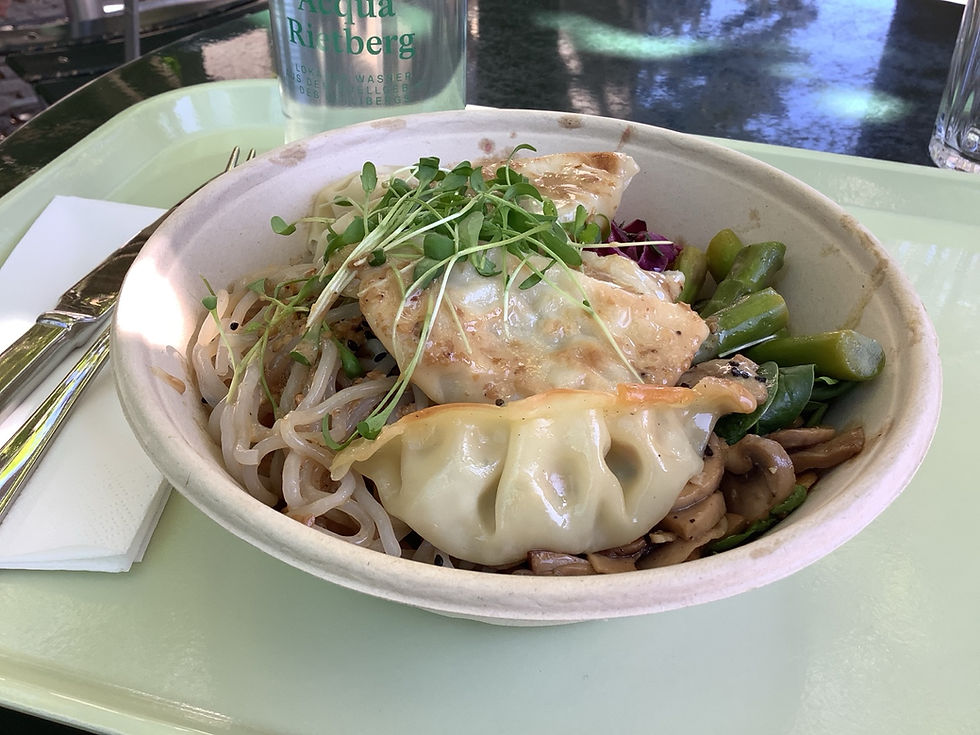
The chewy glass noodles were lightly coated in a delicate umami-rich sauce—flavourful, yet never heavy. While the dish carried Asian influences, the overall impression was light and balanced, with the understated elegance that feels just right for a museum café.
After the quiet experience of the exhibition rooms, it didn’t feel like stepping abruptly back into daily life. Sitting by the garden, watching the shifting light through the trees, the transition felt gradual—like slowly letting the experience settle. Even the bottle of Acqua Rietberg on the table looked beautiful. Lunch here felt like a continuation of the museum visit itself.
The café menu also included bowls such as chicken katsu with rice, edamame, egg, and green beans with sesame, as well as soba noodles with sweet potato katsu, asparagus, and shishito peppers. Rather than a typical bento, each dish felt more like a thoughtfully composed meal, with starters and main elements gathered together in a single bowl.
Exhibitions, architecture, gardens, and café time.
Museum Rietberg is a place to visit not only for art, but also on days when you want to pause and reconnect with your senses. Although it is located in the city of Zurich, the atmosphere gradually becomes quieter as you approach the entrance. Even that short walk felt like part of the Museum Rietberg experience.
How to Get to Museum Rietberg
Museum Rietberg is easy to reach by public transport from central Zurich.
From Zurich Main Station (Zürich HB), take the S24 to Zürich Enge. From there, it is a short walk through the park to the museum.
Because the museum buildings are spread across a spacious garden, the café and shop are often the first things you see on arrival. The exhibition entrance lies a little further inside, so the walk through the greenery becomes part of the experience itself.
About Author

Limi BOLOMIER
Based in Switzerland, Limi Bolomier is the founder and editor of Eat Well · Feel Well · Live Well, a bilingual media platform covering food, beauty, well-being and lifestyle. Drawing on her certification as a Beauty Food Meister and her studies in aromatherapy and herbalism, she writes about recipes and practical approaches to nurturing beauty and well-being from within.


